
Playing Favourites
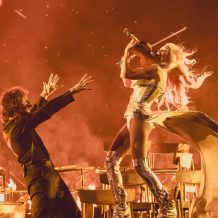
A couple of curveballs have been thrown by the EBU regarding the two semi-final pimp slots this year, awarded to Serbia and Norway respectively. And that’s on top of the strange state of affairs ESC traders are confronted by already.
We’ve rarely seen two semi-finals as diametrically opposed as these. In semi 1, quality is so severely lacking it has a very low qualification bar; semi-final 2, in comparison, offers a much higher standard across the 15 songs, and is essentially a bloodbath in terms who makes it through to the grand final.
In semi 1, you also have an enormous contrast between the first half, where the stronger entries lie, and the second half, which probably features the weakest sequence of songs we’ve ever seen, certainly in terms of the last five, and that run from Belgium through to Serbia.
In semi 2, this is flipped on its head with the first half looking much, much weaker than a stacked second half, in which 7 and, quite conceivably, all 8 entries could qualify. Curiouser and curiouser…
Semi 1 is going to open with an uptempo raft of entries, all of them having their own clear USP. Take your pick from Moldova’s energetic, nationalistic anthem; a slice of slickly-produced EDM from Sweden; Croatia’s epic, ethno track ‘Andromeda’; and the techno-infused ‘Ferto’, which also combines traditional Greek elements.
After those four, does Portugal risk being a toilet break, or will it stand out as a calm oasis, and be aided by the return of juries? Portugal has had a knack for sneaking through semi-finals in the last three years, and largely outperforming expectations.
Semi 1 is going to open with an uptempo raft of entries, all of them having their own clear USP
Georgia could be at greater risk. Bzibeki are sure to perform the song professionally but it could find itself fading into obscurity with the big fan favourite of the year, Finland, following it in terms of the actual semi-final, with Italian crooner Sal Da Vinci offering something for the middle-aged housewives of Europe, as an intermission in between.
Finland owes the EBU a big thank you for being handed effectively its third semi-final pimp treatment (last to perform in the first half) in the last four years. This is running order favouritism that’s hard to ignore. Do the other delegations have grounds for complaint?
We have some compelling evidence of Nordic nepotism in recent years, in particular when it comes to Finland and Sweden. After being granted the semi-final pimp, Kaarija drew first half in the grand final in 2023, and was given the 13 slot (the first half pimp). Last year, after also being granted the semi-final pimp, Erika Vikman drew first half in the grand final, and was also given the first half pimp slot of 13.
If Linda and Pete draw first half in the grand final, who would bet against them being given the 13 slot too? It will likely be the 11 slot at worst. If they draw second half or producer’s choice, a prime position in the running order around 19 to 23 looks assured.
The EBU is clearly aware of the odds but might it also be partly a case of giving ESC fans what they want? Last year, Sweden was around Evens favourite on the morning of grand final day and Kaj were handed the prime 23 slot in the grand final, as a producer’s choice let’s not forget, despite only coming fourth in the semi-final.
Finland owes the EBU a big thank you for being handed effectively its third semi-final pimp treatment in the last four years
Fellow fan favourite Estonia, which also drew producer’s choice, was extremely hard done by, handed the 3 slot in the grand final. And it was only 5pts behind Sweden in fifth place in that same semi last year from its earlier running order position in the 4 slot, with Sweden in 6. Where’s the even-handedness in that?
You then look at the relative treatment of ESC minnow Montenegro, which was doomed after being given the two slot in its 100% televote semi-final last year, and has now been given effectively the opening slot of the second half of semi 1, when it merited consideration for the pimp.
Despite this setback, Montenegro remains on a big ‘borderline qualifier’ list in semi 1 prior to seeing how everything scrubs up live in Vienna. It’s only really Israel that carries certain qualifier status in the second half.
Serbia’s qualification chance has been enhanced having been granted the pimp, but the return of jury/televote semi-finals this year means the televote boost associated with the pimp doesn’t necessarily equate to guaranteed qualifier status.
This latest outing by Belgium’s Essyla suggests it is under major threat of NQ.
The two Baltic nations, Estonia and Lithuania, bring two sub-standard efforts but given the low qualification bar in semi 1 they both have a chance of qualifying, and confusing the picture in the Top Baltic market.
Which brings us on to the intriguing case of Latvia in semi-final 2 this year. It’s seemingly a jury-friendly song. The difficulty for it is, semi 2 is the exact opposite of semi 1 in being chock-a-block with entries possessing jury-appealing qualities.
The two Baltic nations, Estonia and Lithuania, bring two sub-standard efforts but given the low qualification bar in semi 1 they both have a chance of qualifying
Not only that but Norway, which was looking like a borderline qualifier, in the context of a very strong semi-final 2 this year, now has the pimp slot. And if you’re comparing Serbia and Norway, Norway probably has more grounds to feel secure now in its qualification prospects performed from the pimp.
And if Norway is in, then it’s tougher for Latvia. You also have Albania in that second half, and while it looks the weakest entry in that second half, Albania has a tried and tested history of floating around 10th place in semi-finals. From 2018 to 2023, Albania finished 8th, 9th, 10th, 12th and 9th in semi-finals, and this entry feels like it’s in a similar ballpark to those entries.
In the much weaker first half of semi-final two, the EBU appears to be banking on Bulgaria being strong enough to qualify from the opening berth, and then you have the gambled on Romania in the 3 slot which many ESC traders consider a sure qualifier, given it is being backed as low as 1.55 to finish in the top 10.
Azerbaijan, Luxembourg, Czechia, Armenia, Switzerland… could it be that only one of these nations ends up qualifying from the first half, or maybe even none?
Cyprus will open the second half of semi two and while being a fan favourite, it is at risk of falling down on the jury side in semi 2 because Antigoni is by no means a secure and strong conveyance as a live performer.
Azerbaijan, Luxembourg, Czechia, Armenia, Switzerland… could it be that only one of these nations ends up qualifying from the first half, or maybe even none?
We know Ukraine is qualifying, and jury-appealing Malta looks like being aided having been granted the penultimate slot. Denmark and Australia, the perceived favourites to win semi 2, have curiously been placed back to back towards the start of the second half. Is this to test out which one has the stronger winning chance come the grand final, and hence merits the bigger leg up?
Many will consider Ukraine a contender to win semi 2 as well, given its guaranteed big televote. But the song is a wishy-washy ballad and clever staging notwithstanding (this is Ukraine after all), Leleka is by no means a strong live performer or vocalist. Definitely not in the context of following the stellar Delta Goodrem for Australia.
The winners of these semi-final running orders are definitely Finland, Serbia and Norway. And three of Finland’s main market rivals in Greece, Denmark and Australia have been treated much less favourably.
Come the grand final, unless they pull out second half draws, we can probably anticipate both Israel and Ukraine positioned early on, as has been the case in the last two years.
The EBU will look at the jury and televote splits in deciding its grand final running order, as much as it always wants to try and press home the message the semi-final results have no bearing on this.
Above all else, we need to get back into the ESC 2021 and 2022 mindset in trying to figure these two semis out. We do now have the ROTW televote in operation for both semi-finals and the grand final, but it’s essentially a return to the semi-final 50/50 televote/jury split – 50.7 televote, 49.3% jury to appease all the pedants out there.
Come the grand final, unless they pull out second half draws, we can probably anticipate both Israel and Ukraine positioned early on
Belgium (9th place) drawn 11 in semi 1 in 2021, Switzerland (9th place) in semi 1 in 2022 from the 4 slot, and Azerbaijan (10th place) in semi 2 in 2022 from the 4 slot perhaps serve as the strongest reminder entries with solid jury appeal can and will make the cut.
This year’s juries have increased from five to seven jury members, two of which must be aged 18-25. Jury members have to rank all songs based on four main criteria: vocal capacity of the artist(s), performance on stage, composition and originality of the song, and overall impression of the act.
In the last two years, we have had Even money favourites on the morning of the grand final – Croatia in 2024 and Sweden in 2025. This is a cautionary tale if backers are already counting their money on Finland winning this year, as its price shortens with each passing day.
The first rehearsals will get underway this year on Saturday May 2, at Vienna’s Wiener Stadthalle. For ESC traders, it will be the familiar format of trying to assess the photos, videos and descriptions that turn up on social media and eurovision.com throughout the rehearsal period.
It won’t be until Monday May 11 that we will get to see, crucially, the first TV rehearsal of semi-final 1. Ditto, the first TV rehearsal of semi 2 on Wednesday May 13, and the grand final on Friday May 15.
EntertainmentOdds will be on-site in Vienna, seeking to gather all the vital intel, and back for a full preview of semi-final 1 on Tuesday May 12. Keep an eye on X for analysis and updates posted throughout – @ferrisdayoff and @entertainodds.
Related Posts
-
 Best To Worst?
Posted on Oct 23, 2026
-
 Delta Blow
Posted on Oct 16, 2026
-
 The Turner Prize
Posted on Oct 9, 2026
-
 Johnny B. Goode
Posted on Oct 2, 2026
I come to the contest late this year after ignoring most of the selections etc due to being busy on the financial markets,probably the first time iv done that.The Scandi/western bias really stood out as i went through the songs and the prices.
Finland of course looks a winner on the surface,but gosh it would be a horrible one.Its dated cliche.Then Australia,is it AI?,it has less depth than a puddle on a hot summer day.
Denmark we get some quality,but hardly general appeal.Greece,Sweden,yeah enjoyable.
France?,not really.
The contest has suffered badly the last several years through bias against the east/Balkans and interest groups who think they own the contest.Juries have failed to do their jobs for a long time.Not all juries,but across the whole,again damaging the contest.
For me the two stand out entries are Romania and Croatia.Iv been backing both across different markets,four figures on Romania on the win market 55+,jury win,televote win,top 4,semi win,semi top 3,Croatia top 10,top 5,jury win,win market (likely il sell)
I will likely sell Romania stake ,i could now but it looks a 12s max shot to me,so il wait.
I think Alexandra Căpitănescu is one of the most exciting talented artists iv seen for a long time.The song is very very clever and her delivery is epic.
Croatia is divine.An amazing structure and story telling with probably the most epic key change iv heard at ESC that keeps hold right through the chorus and refrain.I know everyone and his dog thinks Australia wins the jury and on past results it likely will,but 100s+ for Romania and Croatia to do it?.Thank you very much.If the juries were doing their jobs,one of them should.As ever shortening into the contest to sell stakes would do fine.I hope you are all well.
Great to hear your views, Durham, and I think you’ve hit on a lot of home truths there. It was a huge loss to the Contest when Ola Sand stood down and a lot of the decision-making since his departure has been poor imho. The rot started to set in in 2022 and in 2024 they had a great chance to reinvigorate all the Balkan region by helping Croatia win but they chose not to.
I also question the selection process and overall professionalism of the juries, and think a much more sensible scoring system would be asking jurors to rank only their top 10, not the entire field which sends the exercise into convoluted, almost random territory.
Also think Romania is excellent and could outrun its odds. Croatia a bigger punt but we saw what Tautumeitas managed last year so you never know…
I think the biggest damage of the contest is not the song quality per se, Finland, or just the juries. Please allow me to explain with as much nuance and context as possible.
First of all, I think music in itself is a relatively nuanced timeless construct. If you look solely to songwriting skills, melody constructs, how compositions are made, the choice of instruments, and leave out emotional impact (which Eurovision is about in abundance), then a Portugal 2017 (Salvador Sobral) is as dated as Netherlands 1957 (Corry Brokken). But in a way both winning entries had this kind of cinematic quality. And at the same time, we found Salvador Sobral groundbreaking and ‘new’, especially when compared to more recent Eurovision winners.
The same goes for an entry like Italy 2021 (Måneskin). While totally different from Salvador Sobral and Duncan Laurence, it could also be seen as some sort of reincarnation of Led Zeppelin or Red Hot Chili Peppers, which finally now made its way to the Eurovision stage. So, in essence it is both new/groundbreaking as well as dated and ‘we have seen this before’.
Hence I am not that negative about Finland this year. What both Pete & Linda are showing is a masterclass of fusion genres performed in a duet setting. There’s a bit of pop-rock in it, as well as Loreen-esque dance and classical-crossover music. “Liekinheitin” is both impactful and has a melody that sticks (catchy; basically all Eurovision winners are profoundly well designed melodies). This duet is emotional impactful as well. Whereas The Common Linnets shined as a tender, soft and cosy relationship-interplay, Pete & Linda go full throttle be conveying an emotionally impactful relationship rage. So perhaps it is dated in a sense, but at the same time it’s also the best ever potpourri of music genres. Dated, yet also new and original.
The biggest problem that the contest is going through IMO is therefore not per se Finland 2026 or the AI-prone look and feel of Australia 2026, but more how the current competition in a post-COVID world is modelled.
Financial continuity of the contest is under great ‘threat’ (even mentioned by former EBU Reference Group chair Bakel Walden). Because of radically declining viewing figures from traditional TV-sets, rising energy prices (has considerable effect on three-phase electricity use), extremely tight budgets from public broadcasters and the abundance of social media, the margins and profits (ROI’s) from the actual Eurovision Song Contest has become extremely tight.
The Pandemic and subsequent geopolitical World War-esque conflicts (Russo-Ukraine War, US/Israel-Iran/Gaza/Lebanon War) have made them even tighter. And because the continuity of the contest is now paramount to the EBU, the biggest sacrificial lambs right now are competition fairness and the ‘Olympic’ spirit of sportsmanship (EBU occasionally mentions Eurovision as the ‘Olympics’ of popular music). Because now we are faced with:
– Competition rules that are open to too broad interpretation (Norway 2023: lead vocals were on backing tape the first 30 secs!; Finland 2026 vs. Luxembourg 2026: Linda can play the violin LIVE, Eva Marija nót),
– Too much ad-hoc competition tweaks without democratic checks-and-balances (ridiculous producer authority and hollowing out the fair instrument of random draws),
– The actual absence of better, more legally verbalized competition rules (bad enforcement by the mutual framework of delegations),
– A jury system that had its flaws on display (Eurovision 2022, no national notaries, using jurors as a ‘correction method’ for televoting ridiculousness),
– But even worse, a current public voting system, ‘televoting’, that instrumentalized ‘political’ voting, lobbying and emotional sympathy and lost its credibility as a democratic voting instrument where people are facilitated to vote fairly and dispassionately.
On top of that, social media and the hypes that the EBU is facilitating with it, has wrongly facilitated the new self-fulfilling prophecy function of both betting odds (can we destroy Polymarket crypto-trading greed?) and fan polls, and are now monumental to such results and changes. Unfortunately, such changes are the wrong ones and move the contest into directions that facilitate even more greed and discord. A direction that IMO is now unique to all the ‘minor’ politics of the entire era 1956-2019.
With all these geopolitical clusterfucks happening, it is only logical that there are boycots this year. Coming Saturday will once again show how radically damaged the competition is (please watch the televoting Saturday and you’ll notice). In recent decades we had some minor changes that helped making the contest better:
– The first real postcards and interval act (Amsterdam 1970),
– The first computergraphical scoreboard (Dublin 1988),
– Seeing the spokespersons for the first time as a means of transparency (Dublin 1994),
– The introduction of televoting (Birmingham 1997) that we still have as of today,
– The re-introduction of juries that compensated for Turkish diaspora (Moscow 2009).
However, if the contest wants to stay a credible, fair, serious, true ‘Olympics’ of popular music (because in its core it still is a jury sport), this decade of clusterfucks soon needs to be followed by the most radical revolution of competition changes since 1956. A revolution of:
– Better and stricter rule enforcement,
– Newly created competition rules that leave NO space for various interpretations,
– A radical new audience voting system (think about: geoblocked and paid-per-creditcard ranking app, or a Melodifestivalen app with age groups, or dividing the Grand Final into three coherent ‘Heats’ of 8/9 songs each of which have non-exchangeable and unique voting windows) to flatten excess points distributions that we now structurally have with Israel and Ukraine, ánd
– A running order that reintroduces the element of a fair random running order draw and doesn’t squeeze out the very function of it like we have now (only leave the ‘color coding’ of songs to producers, but ónly that).
If and when we see such a radical change happening to the contest, we can only slowly purge the negative instrumental politics that Russia and Israel introduced in the contest (the backstage damaging lobbying in Geneva, the social media voting campaigns, the hate facilitation of actual governments, the shameful propaganda) and return to the more good old ‘sane politics’ of announcing one’s votes in a dispassionate way with some frowns.
And in the process we can also bring back some unpredictability during the scoreboard visuals of the Grand Final (Wouldn’t it be fantastic if a song can barely WIN again from a dreadful running order spot #1 or #3? I think it can). You bring back entertainment in a more durable way, perhaps financially too.
So therefore I think one needs to be careful at blaming participating countries like Finland or regions like Scandinavia. Finland IMO serves exquisiteness and creative flair within the current competition framework. It is the EBU though that must be forcefully summoned to radically overhaul this competition framework in a fairer, ethically better aligned, effective, less polarizing ánd more entertaining direction.
And, not not just stick into all too serious subject matter, here’s my pre-rehearsal TOP 13 prediction from mid-April:
01. FINLAND
02. ITALY
03. UKRAINE
04. FRANCE
05. LITHUANIA
06. GREECE
07. AUSTRALIA
08. ISRAEL (will sadly, again, be higher: negative sentiment of the US/Israel-Iran/Lebanon War has worn out)
09. CYPRUS
10. MOLDOVA
11. MALTA
12. BULGARIA
13. CZECHIA
My personal favourites TOP 13:
01. LITHUANIA
02. UKRAINE
03. CZECHIA
04. ITALY
05. LUXEMBOURG
06. LATVIA
07. SWITZERLAND
08. MALTA
09. CYPRUS
10. CROATIA
11. ALBANIA
12. BULGARIA
13. FRANCE